Beyond the Borders: Chinese Mobile Game Publishers Conquering Global Users


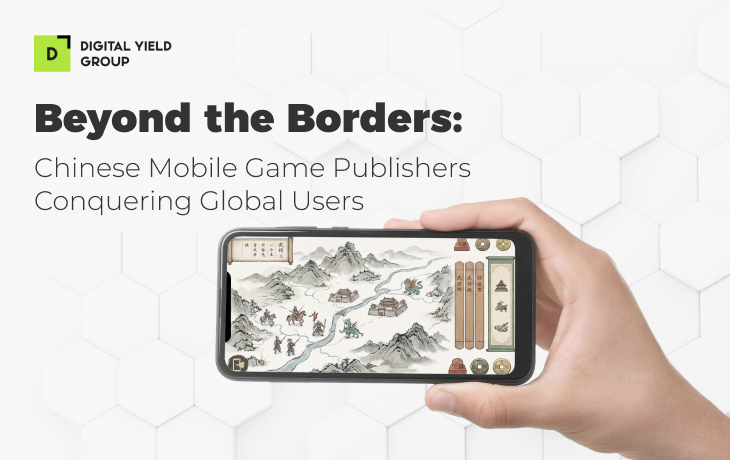
After a post-pandemic slump, the mobile gaming industry has entered a fierce new era of expansion. With the domestic market maturing and regulations tightening, Chinese giants like Tencent, NetEase, Century Games, and Mihoyo aren’t just expanding overseas anymore — they’re actively reshaping what the global games market looks like. In 2025 alone, global UA spend hit a staggering $25 billion, driven by a “multi-front war” where AI, genre-mashing, and a relentless focus on high-spending “whales” have become the new rules for survival.
Chinese publishers have captured the essence of a critical shift from volume-based growth to value-based monetization better than almost any other cohort, securing 35% of all global gaming UA costs outside of mainland China. Our newest report analyzes the mechanisms behind this expansion, examining how technological innovation and psychological mastery are allowing these publishers to claim significant territory in the United States, Europe, and Latin America.
The Global Penetration
The $25 billion surge in spend is not a byproduct of inflation, but a reaction to the “creative surplus” generated by AI, which has flooded every major ad channel with content, raising the bar for standing out.
In the United States, the competition has reached a fever pitch. Chinese publishers have aggressively targeted this high-value demographic, with four of the top ten mobile games in the U.S. now originating from Chinese companies.
The expansion into Europe has been particularly notable for its depth. In Spain and Italy, iOS UA spend from Chinese publishers increased by over 140%, fueled by aggressive campaigns for “Merge” and “Strategy” titles. This success is rooted in cultural fluency; publishers like Lemon Microfun have tailored their narrative-driven merge games, such as Gossip Harbor, to resonate with Western European sensibilities, focusing primarily on quality and sustainable growth rather than just volume.
While the U.S. and Europe represent the “revenue strongholds,” the fastest-growing regions for Gaming UA spend in 2025 were emerging markets. Latin America, particularly Brazil and Mexico, has become a vital target, with mobile game downloads in the region accounting for 19% of China’s total international downloads. Thanks to the rollout of 5G infrastructure, even mid-range phones can now stream high-quality games that were once unplayable, opening a massive window for hybrid monetization models that blend in-app advertising with low-friction microtransactions.
The Genre Metamorphosis
The traditional silos of mobile gaming (Casual VS Midcore VS Hardcore) have essentially dissolved in 2025. This genre mashup, sometimes referred to as “SLG+X”; Strategy Life-Simulation plus X-mechanic, is also a response to the rising cost of acquisition. By blending the low-friction entry points of casual games with the deep monetization of 4X strategy, Chinese publishers have hacked the unit economics of the App Store.
Gen AI has solved one of the industry’s biggest headaches: creative fatigue. Top gaming advertisers are now producing between 2,400 and 2,600 creative variations per quarter; a 30% YoY jump. This shift has turned marketing departments from groups of designers into teams of data scientists who manage “creative ecosystems.” A prime example is Century Games’ Kingshot, which deployed over 3,000 ads per day at its peak. That’s a volume far beyond human limits, made possible only by using AI to track and tweak performance across dozens of global markets.
Titles like Last War: Survival and Whiteout Survival serve as the templates for this new world order. A player might click on an ad featuring a simple math-based shooter or a frozen village simulation; mechanics that are easy to understand and cheap to advertise. However, once the user is engaged, the game gradually introduces deep social competition, alliance warfare, and high-stakes resource management. This transition from “light” to “hardcore” gameplay allows publishers to acquire users at casual-game prices while retaining them for hardcore-game durations.
First Fun’s Last War: Survival has become a global phenomenon, crossing $2 billion in lifetime revenue by February 2025. Its growth has been nothing short of explosive: monthly revenue leaped from $30 million in early 2024 to $138 million by the end of the year. By 2025, it was established as the world’s second-highest-grossing mobile game, earning $1.57 billion (excluding China’s massive Android market).
Century Games has followed a similar “franchise-building” strategy. Their flagship title, Whiteout Survival, generated $1.4 billion in 2025, maintaining its position as a top-grossing Chinese game overseas for 24 consecutive months. The game’s success is fueled by intense social coordination and a progression-focused LiveOps calendar, which saw its overseas revenue increase by 32% in 2025. But Century Games didn’t stop there. Facing the “sequel problem,” they launched Kingshot in early 2025, a medieval-fantasy hybrid that hit $100 million in gross player spending in just 117 days (a faster ramp-up than even Whiteout Survival). With Kingshot crossing $500 million by November 2025, Century Games has officially become a leader in the strategy genre.
The Road Ahead
To keep their 35% share of UA investment outside China growing, leading studios will need to double down on creative testing, incrementality, and LTV optimization across Western markets where competition and user expectations are highest. Success will hinge on pairing AI-driven scale with local insight: tailoring genres, live-ops, and monetization to regional tastes while building recognizable IP that can travel across continents. Publishers that master efficient UA, culturally tuned content, and disciplined monetization will not only defend their gains in North America and Europe, but also deepen and professionalize their already substantial foothold across Southeast Asia and Latin America, turning these “early strongholds” into long-term profit engines.