The Economics of Attraction: Gender ROI Gap in Mobile Dating


The digital dating industry, a behemoth with a revenue valuation of $3.24 billion in 2026, stands at a precarious juncture. To the casual observer, the sector appears robust, with forecasts suggesting a climb to $3.51 billion and a user base expected to exceed 475M by 2030. Yet, beneath these macro growth figures lies a structural fragility that is driving a fundamental shift in the vertical’s profitability profile. This shift is not technological, but demographic and behavioral. It is the widening gap between the cost of acquiring male users and the ability to retain female users: a phenomenon best categorized as the “Gender ROI Gap.”
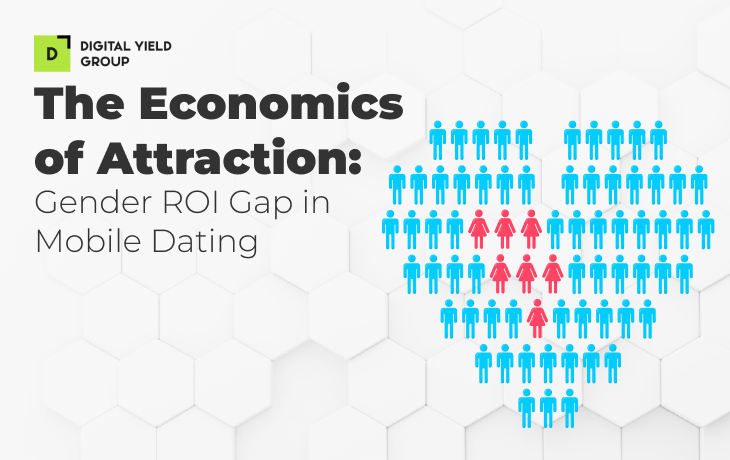
For nearly a decade, the prevailing business model of the dating industry has mirrored the economics of a high-end nightclub: facilitate entry for women to attract men who are willing to pay a premium for access. In the app ecosystem, this translates to a freemium model where men are disproportionately responsible for in-app purchases (IAP) and subscription revenue. Data indicates a stark behavioral asymmetry: men swipe right on approximately 60 – 65% of profiles, while women swipe right on a mere 5 to 9%. This creates a marketplace characterized by an abundance of male demand and a scarce, highly selective supply of female engagement.
The crisis emerges when this ratio tips too far. When the gender balance skews heavily male (as seen in markets like India where ratios can reach 90:10) the ecosystem may collapse. Men, facing a wall of rejection and silence, churn out of frustration. Women, inundated with low-quality attention and harassment, churn out of exhaustion. This “dating app fatigue” has reached critical mass, with 78% of users reporting emotional or physical exhaustion from these platforms.
Therefore, one of the most critical KPIs for a dating app in 2026 is not total downloads or even MAU; it is the “Female Retention Rate”. A female user is not merely a single data point; she is the liquidity provider for the entire marketplace. Her presence retains multiple paying male users. Consequently, the ROI for acquiring a high-intent female user is exponentially higher than that of a male user, yet the industry continues to struggle with strategies to effectively engage this demographic without relying on reductive stereotypes or ineffective “pink-washed” marketing.
This report explores how leading platforms like Bumble, Hinge, and emerging challengers are re-engineering their UA and retention strategies. It examines the shift from “volume-based” marketing to “safety-first” branding, the role of AI in curating healthier interactions, and, crucially, how sophisticated programmatic advertising strategies can be leveraged to restore balance to the ecosystem.
Quantifying the Gender ROI Gap
To understand the Gender ROI Gap, one must first deconstruct the flow of capital within a dating app. The revenue model is fundamentally different for male and female demographics, creating a complex interplay between direct revenue (subscriptions) and indirect value (engagement).
In the dating vertical, the “whales” are almost exclusively men. Studies show that men are far more likely to pay for premium features (unlimited swipes, “Super Likes,” and profile boosts etc.) to overcome the inherent competitiveness of the platform. For instance, Tinder’s revenue, which surpassed $1.9B in 2024, is driven largely by these micro-transactions and tiered subscriptions like Tinder Gold and Platinum.
If the ratio of men to women becomes too asymmetrical, the value proposition for the “whale” evaporates. He is paying for visibility in a room where no one is looking.
- The Multiplier Effect: A single active female user can sustain the engagement of dozens of male users. If she leaves, the engagement metrics for every male profile she interacted with (or could have interacted with) decline.
- The Cost of Churn: The cost to acquire a male user (CAC) might be lower in many markets due to higher intent, but his Lifetime Value (LTV) is entirely dependent on the presence of women. Conversely, acquiring a female user might have a higher CAC due to lower intent and higher skepticism, but her retention is the “anchor” that secures the LTV of the male cohort.
The algorithms powering these platforms often exacerbate the gap. Collaborative filtering, a common method used to predict preferences, relies on past behavior. Since men swipe right indiscriminately and women swipe selectively, the algorithm struggles to determine what men actually like, while simultaneously learning that women are “picky”.
This results in a feedback loop:
Men receive few matches, prompting indiscriminate swiping to boost odds.
The app interprets broad swiping as low standards, further diluting profile quality.
Women are overwhelmed by a high volume of incompatible likes.
Overwhelmed by low-quality interactions, women disengage and exit the platform.
The overall signal-to-noise ratio collapses for all users.
The economic impact is tangible. Match Group and Bumble have faced significant market value fluctuations, losing an estimated $40 billion collectively since 2021. This “correction” is a direct response to the market realizing that the “infinite growth” model is unsustainable if the core product – human connection – is broken by imbalance.
Dating apps that fail to monetize female users directly are leaving money on the table. However, monetizing this demographic requires a different value proposition. Women are less likely to pay for access (since they already have it) but are increasingly willing to pay for control, safety, and efficiency. Features like Bumble’s “Incognito Mode” or advanced filters appeal to the desire to curate the experience and mitigate risk.
Trust as the New Currency
If the primary driver of male churn is a lack of matches, the primary driver of female churn is a lack of safety. The data is stark: 57% of women believe dating apps are unsafe, and 56% have received unwanted sexually explicit content.
For a long time, safety features were treated as a compliance necessity or a “nice-to-have.” In 2025, they are the single most critical component of UA marketing targeting women. The “Safety Paradox” is that acknowledging the dangers of dating (which might seem like bad PR) is actually the most effective way to build trust and brand loyalty.
Tinder’s strategic pivot to the “Green Flags Only” campaign is a prime example of this shift. By explicitly marketing its safety suite (Photo Verification, Block Contacts, and Video Chat) as “green flags,” Tinder reframed safety from a defensive necessity to a desirable feature set. The campaign’s success lies in its tone. It doesn’t use fear-mongering; it positions the app not just as a matchmaker, but as a bodyguard.
Competitors have followed suit, escalating the “arms race” for trust. Bumble utilizes an AI-powered “Deception Detector” to block spam and scams before they reach the user, and a “Private Detector” to blur unsolicited explicit images. A new industry entrant RAW markets itself on “100% verification” and a “daily photo” requirement, making catfishing structurally impossible.
Marketing these features is not just about ethics; it is about economics. A platform that cannot guarantee a baseline of psychological and physical safety cannot retain the female demographic essential for its survival.
The Female Gaze in Marketing
Historically, marketing to women in the dating space relied on “pink-washing” or generic messages about “finding love.” The 2026 landscape demands a radical departure from these tropes.
Bumble built its empire on the “Female First” mechanic, challenging the heterosexual norm by requiring women to initiate conversation. This “Sadie Hawkins” approach was a masterstroke of branding, positioning the app as a tool for empowerment. However, the brand’s recent “anti-celibacy” campaign serves as a cautionary tale of misreading the room. The campaign backfired spectacularly: it was perceived not as empowering, but as entitled and dismissive of women’s valid choice to opt-out of a toxic dating market. It reinforced the idea that women “owe” their presence to the dating pool. The lesson: marketing to women must respect their autonomy, including the autonomy to not date.
Hinge has successfully carved out a niche with its “Designed to be Deleted” slogan, which paradoxically drives retention by promising an end to it. By focusing on the messiness and non-linearity of real connection (misunderstandings, awkwardness, timing), Hinge validates the user’s struggle. It doesn’t sell a polished fantasy; it sells the potential for a “plot twist” in an otherwise mundane reality. This authenticity resonates with Gen Z users who are hyper-aware of curation and artificiality. It builds brand affinity by acknowledging that dating is hard, but potentially worth it.
Another surprising trend of the last year is the embrace of “cringe” and “micro-mance”: small, low-stakes gestures of affection like sending memes or playlists. Marketing campaigns that highlight these relatable, low-pressure interactions perform better than those depicting grand romantic gestures. Creative assets that show a couple laughing at a bad joke or sharing a niche interest (e.g., “geeking out” over a video game) signal a more accessible, less performative type of relationship. This lowers the psychological barrier to entry for users who find “traditional” romance intimidating or outdated.
Gaming as the Ultimate UA Channel
A critical, often overlooked strategy in bridging the Gender ROI Gap is the intersection of dating and gaming. Contrary to the dated stereotype of the “male gamer,” women constitute approximately 48% of mobile gamers. This demographic is not only massive but highly engaged, making mobile games a prime, underutilized inventory source for dating app UA.
Mobile gamers possess the traits that make for a successful dating app user. They are already tech-savvy and comfortable with how apps and digital messaging work. Many popular games require patience and strategy, which are the same qualities needed to navigate the slow process of finding a partner. Additionally, because women in gaming tend to stick with their apps longer and play more consistently, they bring a level of steady engagement that is essential for a healthy dating community.
Dating apps can leverage this by placing ads in genres that over-index for female users. In puzzle games, players are already used to the “match” mechanic, so using a dating app feels natural. In Simulation & Role-Playing, making characters and choosing plot lines is the perfect practice for the real-life storytelling people do on dating apps.
Marketing creatives placed in these environments can borrow the visual language of the games. An ad for a dating app inside a narrative game might frame the “swipe” as a “choose your own adventure” decision. By meeting women where they are already having fun, dating apps can acquire users in a state of positive engagement, rather than trying to interrupt their social media scrolling.
The Strategic Imperative of Specialized DSPs
For mobile marketers, the challenge is operationalizing these insights into scalable UA practices. The “walled gardens” of Meta and Google, while vast, often lack the granularity and cost-efficiency needed to target high-intent female users without blowing the budget on competitive bidding wars. This is where specialized DSPs may help.
Major platforms like Facebook and Instagram are saturated: the cost to acquire an engaged female user on these platforms is inflated because every advertiser – from fashion to fintech – is bidding for her precious attention. DSPs have access to diverse inventory sources outside the social giants, including direct supply from mobile games (see above), photo editors, and niche lifestyle publishers. This allows advertisers to reach women where they are engaged (e.g., editing their profile picture) rather than where they are scrolling (social feeds).
DSPs utilize sophisticated machine learning models to identify “lookalike” audiences based on valid data points beyond basic demographics. Instead of just targeting “Female, 18-34,” a DSP can target “Female users who have high retention in puzzle games” or “Users who frequently use health and wellness apps.” These behavioral signals often correlate with the patience and intent required for dating apps.
Placing dating ads in relevant contexts (such as a “romance” themed mobile game or a digital magazine article about relationships) increases conversion rates. This is an “almost native advertising” at scale.
Dynamic Creative Optimization is another tool for bridging the Gender ROI Gap. A DSP can automatically serve different creative variations to different segments.
- Segment A (Security-Conscious): Sees ads highlighting “Verified Profiles” and “Block Contacts.”
- Segment B (Burned Out): Sees ads highlighting “Intent-based matching” and “No ghosting” features.
- Segment C (Gamers): Sees ads featuring gamified elements or “geek” culture references.
The platform tests these variations in real-time, shifting budget to the creatives that drive better engagement signals: registration and first conversation.
Given the high churn rate in dating apps, retargeting is essential. A DSP can execute precise retargeting campaigns to bring back users who installed but didn’t register, or who registered but haven’t swiped in 7 days. Retargeting creatives can highlight new potential matches in the user’s area (“3 new people liked you nearby”), triggering the FOMO and prompting a re-open.
Balancing the Ecosystem
The “Gender ROI Gap” is the defining challenge for the dating industry in the post-pandemic landscape. The “Growth At All Costs” is over; the era of “Balanced Growth” has arrived. Apps that treat female users as a renewable resource will falter; those that treat them as the platform’s most valuable asset (Protection + Respect + Tailored Engagement) will thrive.
Navigating this complex landscape requires a strategic ally. For advertisers seeking to balance their gender ratios and maximize ROI in this volatile vertical, partnering with a specialized mobile advertising partner offers a distinct advantage. In a market defined by noise, the smartest move is to find the collaborator who knows how to amplify the signal. The future belongs to those who can engineer not just a match, but a feeling of safety, value, and respect.